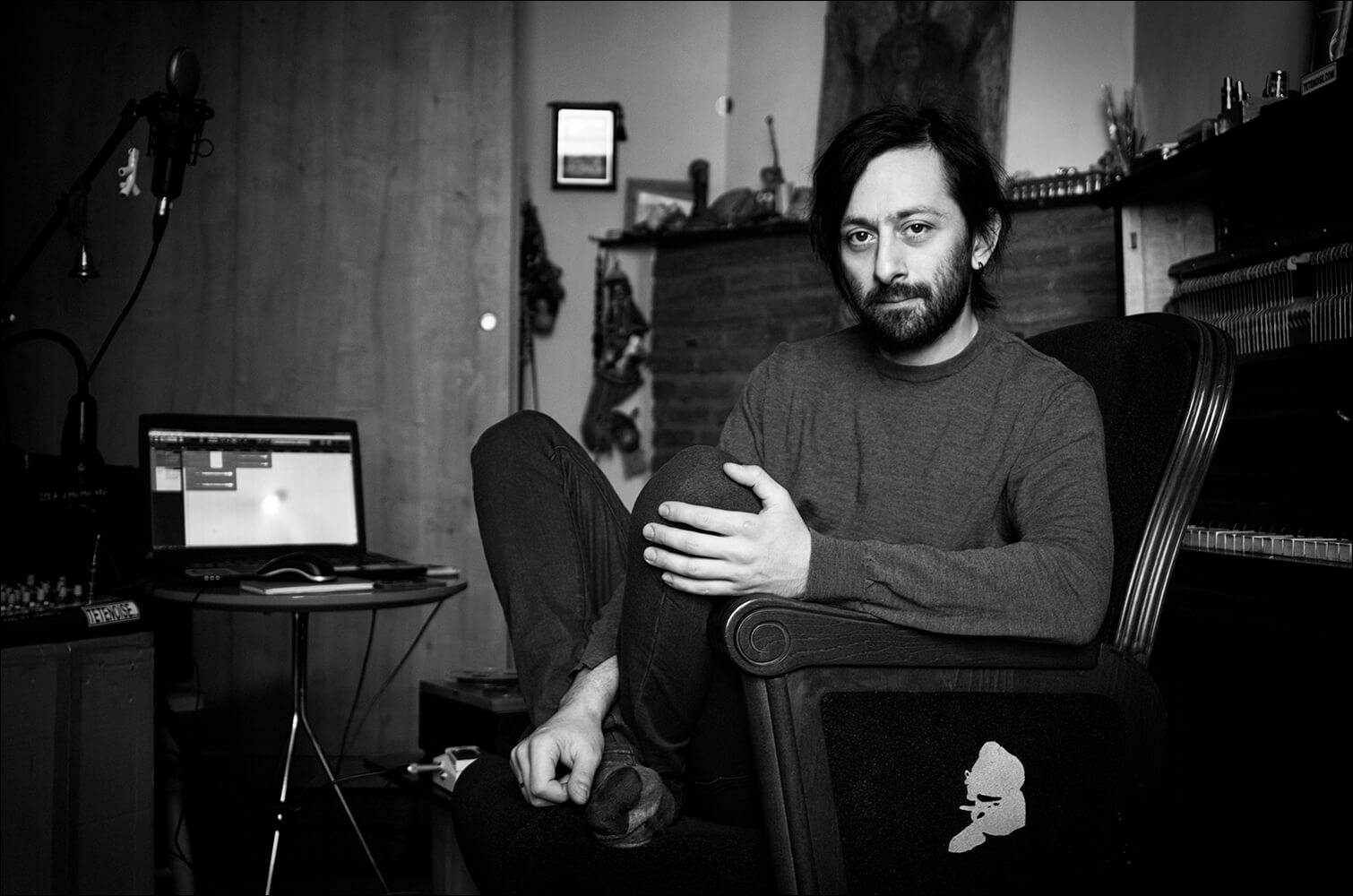
TeTe Noise is the experimental music project of Georgian artist Sandro Chinchaladze. Fusing cassette tape loops, analogue electronics, and field recordings, TeTe Noise creates immersive sonic collages that blur the lines between sound art and music. Often accompanied by abstract visuals and rooted in improvisation, his performances explore themes of decay, memory, and transformation. With a background in electro-acoustic composition and a presence across festivals and art spaces, TeTe Noise stands at the intersection of noise, ambient, and performance art.
You’ve been active on the music scene for many years… Can you talk about your background?
My first gig was in 1998, and since then I’ve been moving through different genres, bands, collaborations, and set-ups. Each phase left a mark on me. All those invaluable experiences shaped not only my sound but also my understanding of what kind of sonic language I want to speak. Over the years, I’ve learned to treat music almost like a living organism—one that grows, mutates, and keeps guiding me toward new forms.
TeTe Noise fuses cassette tape loops, analogue electronics, and field recordings. Can you talk about the sonic universe of TeTe Noise?
I often use instruments in non-traditional ways—like making a hiss out of a choir or stretching strings until they behave like something entirely different. I record these textures on tape or reel-to-reel, and sometimes I intentionally damage the tape to create glitches, cracks, and imperfections. Dramaturgy is essential for me. I try to infuse each piece with a sense of poetry or narrative, but not in a direct way. I want the listener to create their own storyline, their own emotional map, while experiencing the music. The sonic universe of TeTe Noise is more like a place to wander in than something to decode.
Your performances explore themes of decay, memory, and transformation. How do they capture these themes, and how are they connected in your artistic expression?
Decay, memory, and transformation feel inseparable to me. Decay is a kind of truth—it reveals the structure beneath things. Memory is what holds the fragments together, even if they’re distorted or incomplete. And transformation is what happens when you accept both. In my performances, I try to let sounds “age” in real time—loops slowly falling apart, textures eroding, meanings shifting. I’m interested in how something fragile can turn into something new. For me, the beauty lies in that tension between what is disappearing and what is emerging. It mirrors how our own memories work: imperfect, unstable, but still powerful.
What is your relationship to the visual representation of music and its influence on emotional perception, especially in ambient music?
Visuals are an extension of the sound for me. Ambient or experimental music often exists in a more abstract emotional space, and visuals can help shape or expand that space without locking it into one interpretation. I don’t see visuals as decoration; they’re part of the dramaturgy, part of the emotional architecture.
Sometimes images can guide the listener into a deeper state, and sometimes they can disturb the comfort of the sound. I like playing with that tension. The visual and the sonic can contradict each other, or merge, or dissolve—it depends on the performance.
You’re based in Tbilisi and affiliated with Mutant Radio. Can you talk about the scene in Tbilisi right now?
Tbilisi has a very alive and constantly shifting scene. There’s a strong DIY energy here—people build things from nothing, create spaces, and find ways to collaborate. It’s a place where electronic, experimental, club, metal, noise, and traditional influences all collide. Mutant Radio is an important platform in this landscape: it connects artists, supports new voices, and keeps the scene open to experimentation. What I like about Tbilisi is that it’s unpredictable. You never know what kind of project will appear next, or who will collaborate with whom. There’s a sense of urgency and honesty in the way people create here.
What are you currently working on and planning for 2026?
At the moment I’m working on new material with my drummer Giorgi Tetsoshvili. We’ve already had several releases that continue our exploration of tape, analogue textures, and electro-acoustic improvisation.
For 2026, I’m planning to start new experiments with classical vocals and drones.
Interview Lucia Udvardyova